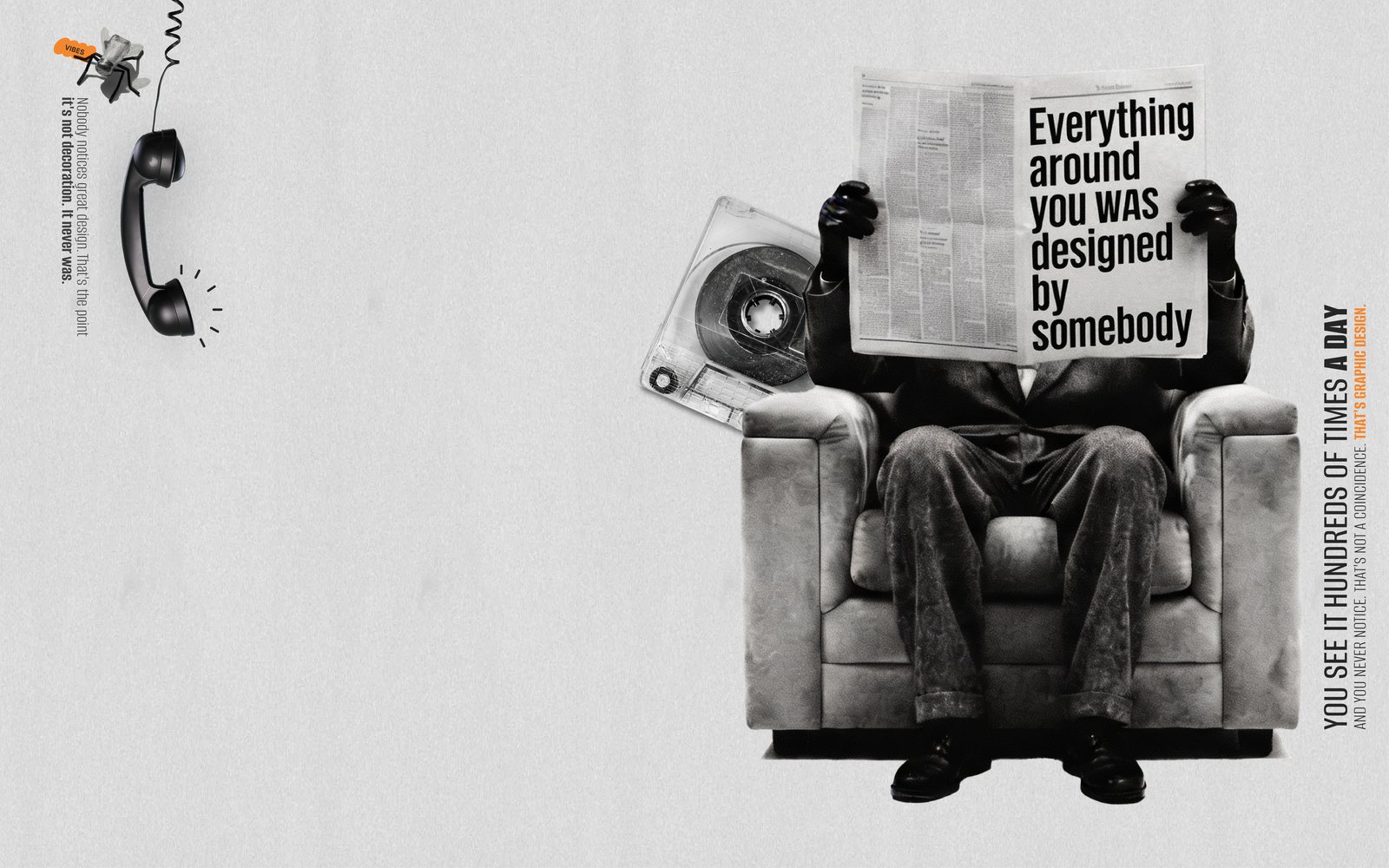
You see it hundreds of times a day, and you never notice it.
That is not a coincidence. That is graphic design doing its job.
The chair you are sitting in. The app you opened this morning. The label on your coffee cup. The sign that told you which door to use. Somebody made a decision about every one of them, and most of those decisions were made so well that you never had to think about them.
What graphic design actually is
Most people think graphic design is about making things look nice. It isn’t.
Graphic design is the discipline of organising information so people can absorb it, navigate it and act on it.
Not decoration. Not art for art’s sake. Structure, clarity and communication.
A good poster tells you what matters before you read the small print. A good menu makes the right dish easy to find. A good website tells you where to look next without asking. None of that is styling. All of it is organisation.
The invisible system
Right now, design is working on you, whether you notice it or not.
A poster makes you feel something before you read it. A website tells you where to look next. A product makes you trust it before you buy it. Each one is a small system built to move you from seeing to understanding to acting.
When it works, it disappears. You only notice design when it fails: the form you can’t finish, the sign you misread, the brand you can’t remember five minutes later.
“Make it look nice” vs. “Make it work”
This is the misconception we hear most. A client asks for something that looks good. What they actually need is something that works.
The difference matters, because looking good is not the goal. It is a side effect. When the hierarchy is right, the message is clear and the system is consistent, the result looks good almost by default. Start with the look and you get something pretty that nobody understands. Start with the job and the look follows.
The three-second rule
When someone sees your brand for the first time, three things happen fast.
- In the first second, they feel something.
- By the second second, they form an opinion.
- By the third, they decide whether to stay or go.
Design controls all three. Before they read a word. Before they click. Before they consciously think. That is why design can’t be the last step in a project. By the time the copy is read, the decision has already been made.
What you are really buying
When you invest in design, you are not buying visuals. You are buying four things.
- Clarity. Your audience understands you immediately. No confusion.
- Trust. People judge quality by what they see before they experience it.
- Consistency. One visual language, across every channel and every market.
- Decisions. Made by someone who thinks in strategy, not just software.
The last one is the one most businesses skip. Tools are cheap now. Anyone can produce a logo, a post or a landing page in an afternoon. What is still rare is someone who knows which one you actually need, and why.
Design is a decision
Most businesses treat design as the last step: the business is built, the product is ready, now “make it look nice.” The ones that win treat it as the first step, because every choice about how they look is really a choice about who they are for, what they promise and how they want to be remembered.
Design is a decision, not a decoration.
So here is the question worth asking: what does your brand say about you before you say anything at all? If the answer isn’t the right one, let’s talk.